


Senator Lindsey Graham (R-SC) unexpectedly died last night from what his staff reported a “brief and sudden illness.” I knew Senator Graham, though we were more decent acquaintances than friends, and there were times when I was outraged by his positions — particularly his tendency to want to throw military force at nearly every national security challenge as a first impulse, and his turning two blind eyes at growing illiberalism in America while being venting at autocrats abroad. Nonetheless, I respected him as he had a way of surfing the political waves in Washington so as to preserve the political and national security equities he cared most about even as the political sands shifted, and he was really funny.
I did consider Senator John McCain a friend, and thus I would see his best Senate pal Lindsey Graham frequently, and had a front row seat while Lindsey, McCain and Joe Lieberman became a hawkish, neocon threesome juggernaut in US national security policy. I was far more of a Nixonian realist in my national security orientation, and Senator Graham and I had some friendly and humorous tangles over that divide for years.
But as I sit this morning pondering the fact that he just left the field without any notice, without any apparent debilitating illness, after an important trip he made to Kyiv, I’m rather overrun by emotion and memories, perhaps too many to have the dispassionate distance needed for an appropriate remembrance — but the key thing I want to convey is that Lindsey Graham was a force, one celebrated by his fans on one side of the spectrum, while on the other loathed by some who saw him as coddling up often to the strongest force in the room and becoming a shape-shifter without political spine.
That latter impression is simply wrong, and I have thought about it for too many hours over many years — trying to understand the Senator. Lindsey Graham cared immensely for the preservation and enhancement of U.S. military power, defense capabilities, and intelligence resources. He always stood up for the soldier, and for the use of those soldiers and weapons he helped secure funding for to sculpt the international order in ways that worked for the U.S. It was a known secret that he very much wanted to be Secretary of Defense in the first Trump administration.
He would have been a vital ally of President Trump in pushing a $1.5 trillion defense request in the upcoming National Defense Authorization Act that is supposed to be introduced for debate next week. Interestingly, Senator Mitch McConnell who had known dramatic differences with Trump would have also lined up support for that military spending authorization bill — and he is apparently in some form of health purgatory at the moment, thus potentially taking off the board for Trump, or at least sidelining in McConnell’s case, two key allies in the NDAA battle.
What comes to mind right now are memories of the Senator that people might be surprised by. I want to share some of them as they may make the picture of Lindsey Graham more complex, which I feel he deserves rather than the binary cliches and over-simplications of his character and political persona that are going to be triggered by his death.
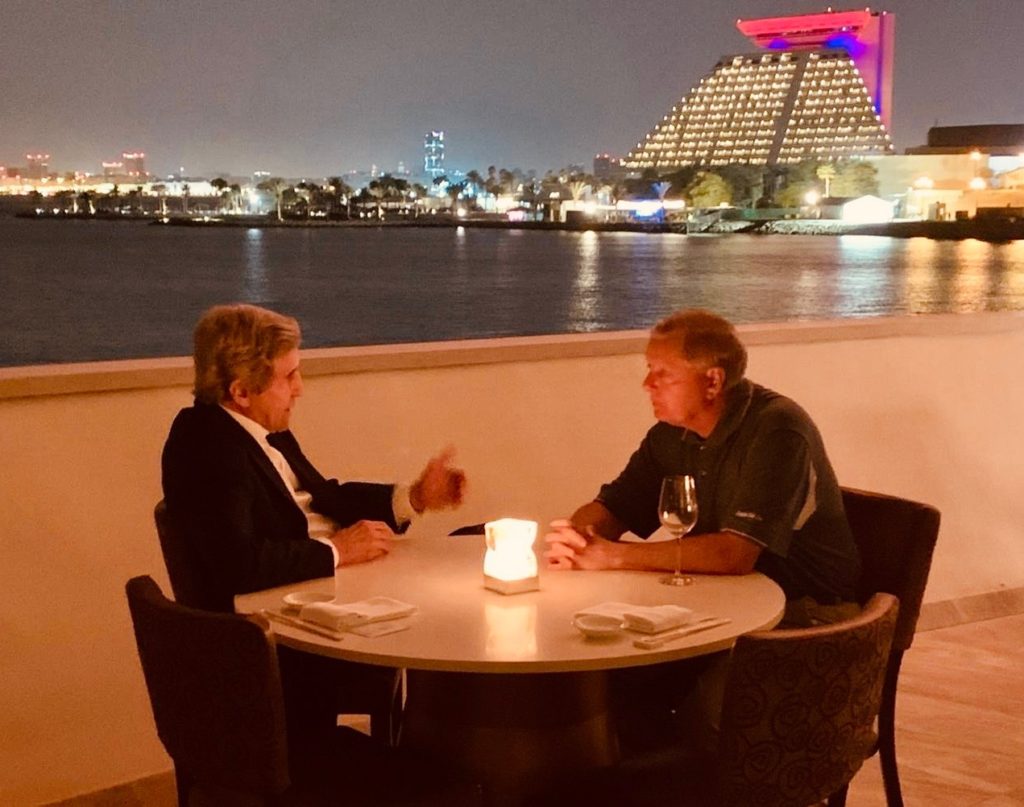
One of the first things that flashed in my mind when I heard news this morning that he had died was a picture of Lindsey with former Senator and US Presidential Envoy on Climate John Kerry on the edge of the Arabian Gulf in Doha, outside Nobu near the Four Seasons Hotel. We were all there for the annual Doha Forum, and the Senator was always colorful, opinionated, witty in ways that worked brilliantly for a room full of the Middle Eastern, American, and European strategic class. But John Kerry was there too — the political antithesis of Graham, pushing severe reduction in carbon emissions in the middle of one of the capitals of global fossil fuel production.
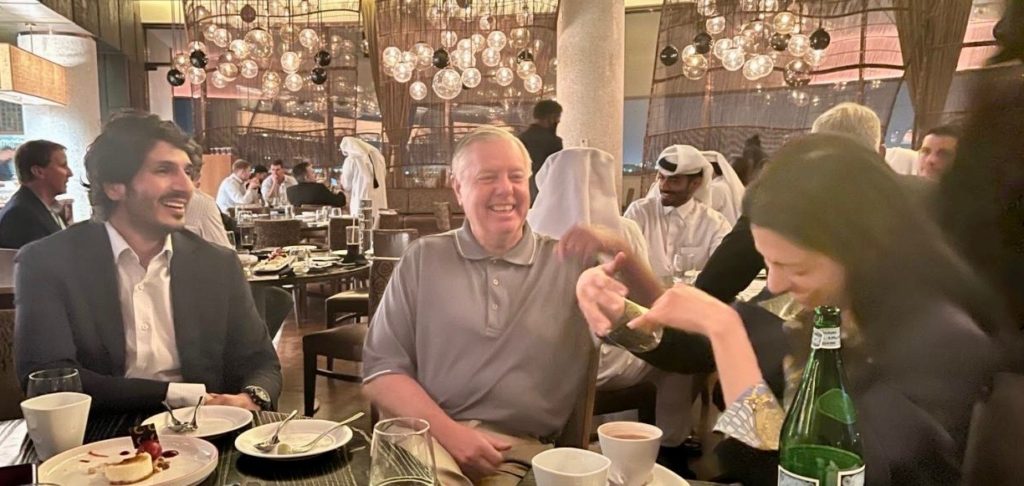
That night, my friend and foreign affairs commentator Fadi Elsalameen, who once flirted with a run as GenX candidate for Palestine’s president, was celebrating his birthday at Nobu with former State Department spokesperson Morgan Ortagus and Senator Graham, some Qatari officials too, and Huma Abedin (long time Hillary Clinton confidante and spouse of Alex Soros) and I then joined the table and the fun. Lindsey Graham was flying high with wit and quick fun jabs at folks.
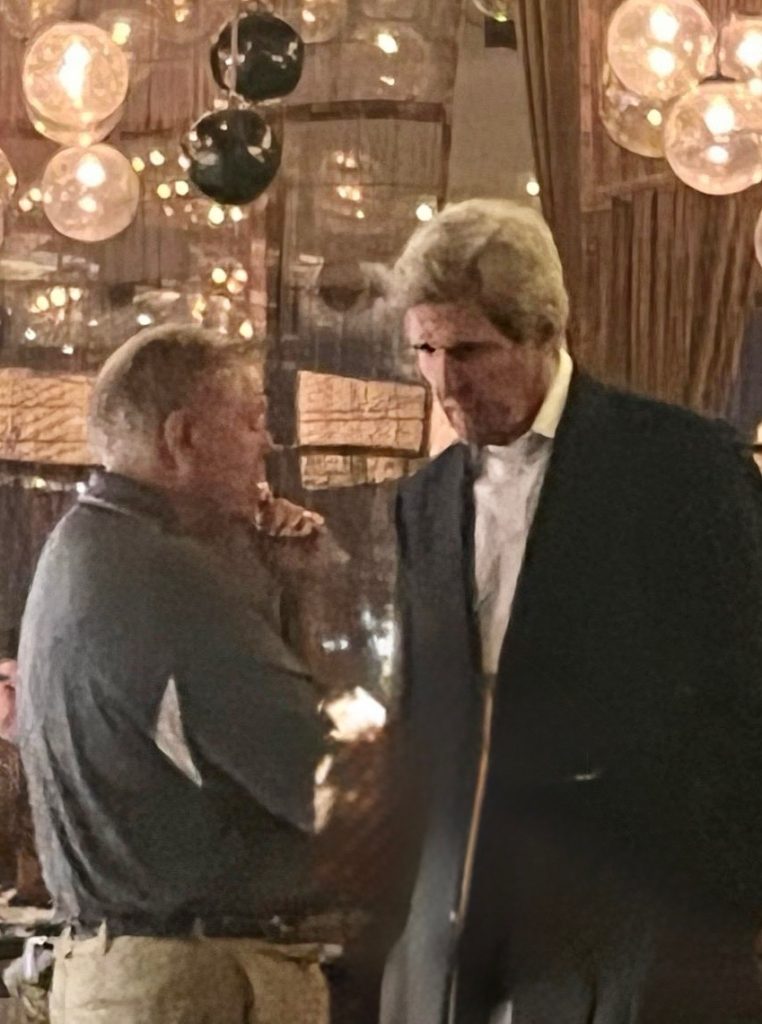
Next thing I know is that the Senator’s good friend and highly trusted permanent aide Andrew King ushered him to a spot on the restaurant patio to have a little private session with John Kerry. They sat in chairs with the lights of a Doha night illuminating them and had what appeared to be a friendly, long conversation. I got a picture of them which has never been published, and I am posting it now. The art of this photo was not just the visual aesthetic of colors and shadows of a Doha evening bouncing off a current Senator and a former one, but for me, something as powerful as Tip O’Neill and Reagan hanging out.
Another time I remember well was when Lindsey Graham sat next to me in the Motion Picture Association theatre when Jack Valenti was running what was then MPAA (and now is MPA). Journalist Margaret Carlson, herself a good friend of Senator Graham’s, used to organize special nights where political notables would name their favorite movie of all time, and then some of us on the Margaret Carlson’s friend list would be invited to watch that film with the Senator or DC power celebrity. This particular night was Senator Chris Dodd’s turn (himself a later CEO of the Motion Picture Association in his post-Senate journey) and Chris chose “A Man for All Seasons” as his movie, of course the tense story about principal colliding with power in the rise and fall of Sir Thomas More. Lindsey sat next to me at that movie, and he would occasionally whisper, “watch this part,” or would say “so powerful,” meaning he was moved by the imagery and message. He was a vulnerable person for that moment — not ironic, not witty, just moved. And it made a permanent impression on me that people like Lindsey Graham were more than what the public saw, and that so much is not revealed, and is kept back. I felt that there was something deeper with Lindsey that evening that made me realize that most of his public life was performance, but if you studied closely, you could occasionally see elements of private passion.
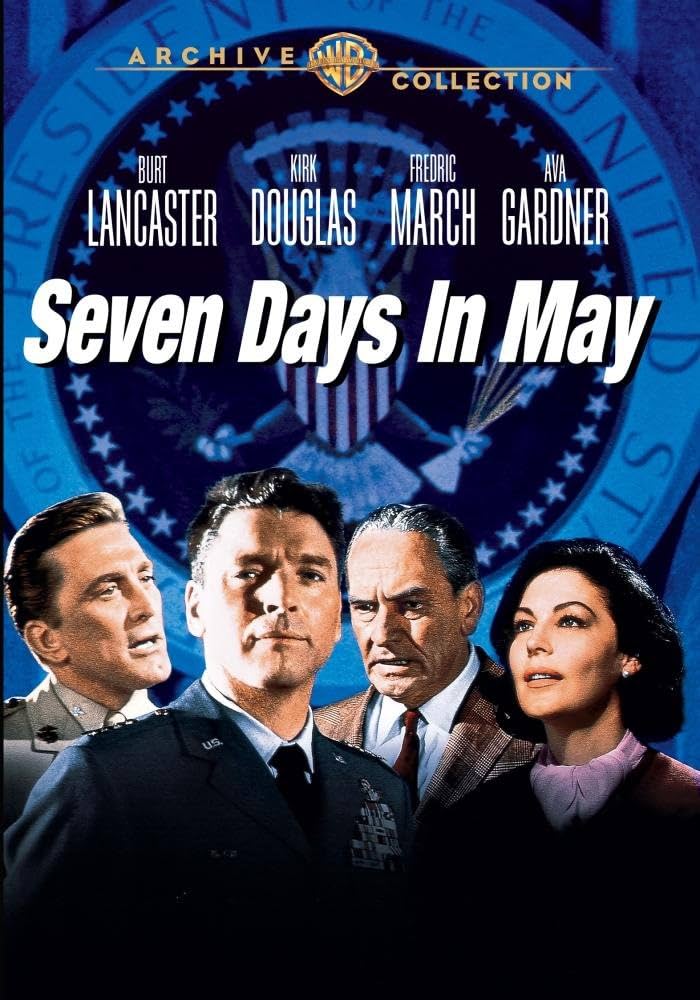
Then it was Lindsey’s turn. Margaret Carlson invited him to pick his favorite movie, and he chose “Seven Days in May,” starring Burt Lancaster, Kirk Douglas, Fredric March, and Ava Gardner. The film is highly misogynistic, but once you get beyond that – wow. It’s a film about militaristic nationalists who doubt the solvency of democracy.
He chose this film when President George W. Bush was in office, and Dick Cheney was VP. I saw this as a brave and memorable moment, and Lindsey said that night that we needed to “beware the demogoguery of military leaders and national security experts.” Would he have said the same in 2026 during the ascension of new forms of demogoguery percolating in the U.S. and around the world? Not sure, but he did say it that night.
And when then Atlantic national correspondent (and now editor in chief) Jeffrey Goldberg interviewed Lindsey Graham years later at the Washington Ideas Festival, I posed the question from the floor to Graham on whether he stood by “Seven Days in May” being his favorite film — and he doubled down that it was and that we always needed to remember the message of that film and preserve our democracy.
Was he a shape shifter on this subject? Yes probably.
But in my view, all the variations of Lindsey’s perspective should be considered when taking stock of his life and impact, and he said publicly — twice — that this film was #1 for him.
Senator Graham just two days ago helped seal a deal with the White House that will bring forward a new set of sanctions on Russia, whom Graham never lost sight of as a key threat to American interests despite the wobbliness of the White House on this subject. He led a key initiative along with Senators Jeanne Shaheen (D-NH), Richard Blumenthal (D-Conn) and Roger Wicker (R-Miss) to impose costs on Russia for its invasion of Ukraine, despite the White House having resisted efforts in the past to limit Moscow’s economic flows. In a joint statement that sounded pretty much like full-throated Lindsey, the Senators wrote “As Russia intensifies its slaughter of civilians, it is imperative that the legislative and executive branches work together to create tools to exact a heavy price on those who buy Russian oil and natural gas, fueling the Putin war machine.”
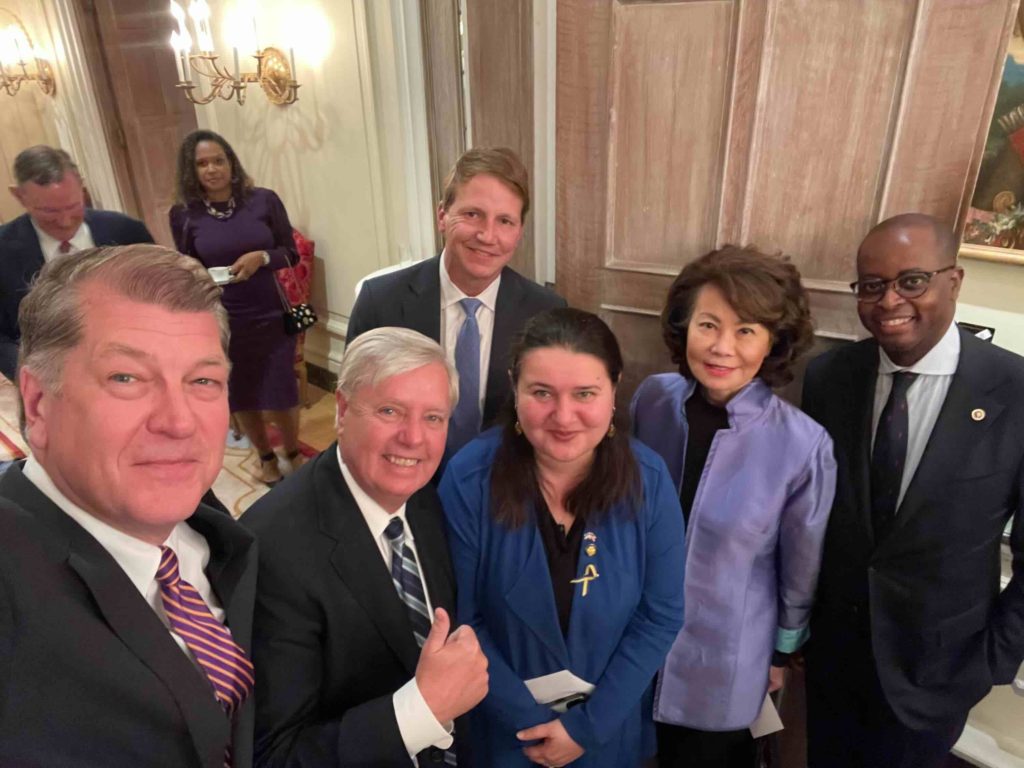
I witnessed first hand Lindsey Graham’s steadfast determination, his ‘north star’ more than anything else I witnessed, in supporting Ukraine against Russian aggression and his deep belief that Vladimir Putin was a dangerous, not to be underestimated global menace. This came about through a dinner party, like so many things in Washington do. This one was hosted by French Ambassador to the U.S. Philippe Etienne in honor of Washington Post doyenne and daughter of the famed Katherine Graham, Lally Weymouth. The other special guest at dinner would be Ukraine Ambassador to the U.S. Oksana Markarova. Both Philippe and Lally had called me days before the dinner and asked for assembling the ‘right group’ for a dinner with Lally. And so I went to work.
My first call was to my friend and loyal long-term Lindsey Graham aide-de-camp Andrew King who personally called the Senator who according to my recollection immediately said “I’m in.” And from there, in literally 24 hours, not only did we have Lally, Philippe Etienne, Andrew King and Senator Lindsey Graham, and Amb. Markarova but we brought in Senator Joe and Gayle Manchin, Senator Jim and Vicki Risch, Senator Dan and Julie Sullivan, Israel Ambassador to the US Michael and Shirin Herzog, Elaine Chao, Howard University President Wayne Frederick, Pascal Confavreaux, Don Graham and Amanda Bennett, C. Boyden Gray, and Jane Harman.
This was a DC power table, but it needed purpose as it started with a lot of unfocused side chatter all around the table. My role that night was to end that and to ask Senator Graham loud enough so that all could hear what he believed was the most urgent issue in Washington at that moment that we should ‘all’ be wrestling with — and without missing a beat, Lindsey said “stopping Putin, rolling him back, working with our friends in Europe and in Ukraine to save Ukraine.”
Lindsey Graham commended Ambassador Markarova and rather bluntly criticized those with ‘weak knees’ in both the Republican and Democratic parties for not understanding the importance of NATO, the solvency of trust between the U.S. and our European allies, and the existential menace of Putin.
What became 100% clear to me after that night is that Graham was willing to endure countless golf course jaunts with Donald Trump, repeated moments of sycophantic obsequiousness on any issue that had nothing to do with Russia, Ukraine or national security, and help to deliver occasional Senate victories for the White House in order to stay in the ‘room where it mattered’ when it came to defense and national security decisions. He had focus when many others didn’t, and he demonstrated steely resolve on the issues that mattered most to him.
Did that frustrate his critics who wanted consistency, who wanted him to throw down the gauntlet on some of the administration’s strident moves on January 6th or the way it treated key allies. Absolutely, but he kept himself relevant and part of Trump’s calculus on Russia and Ukraine — prevailing somewhat in the announcement on Russia sanctions days ago in Ukraine, something that just wasn’t likely just months ago.
I share these memories to share some of the nuance on the meaning and purpose of Senator Lindsey Graham in American political life — not to excuse some of the biggest contradictions and occasional hypocrisy, but to share the fact that there was depth there, purpose, a north star, and the constant prioritization of what he believed mattered most over that which he saw as surface noise.
I never had an encounter with Lindsey Graham that didn’t intrigue, that didn’t make me laugh even when the underlying subject wasn’t really all that funny, and that didn’t leave me wanting more.
Sadly, we will now have memories – and will be debating his influence and character for many years ahead I’m guessing. RIP Senator Lindsey Graham.
— Steve Clemons


4 comments on “Lindsey Graham Dies at 71: Warned Against Military Demagoguery”