

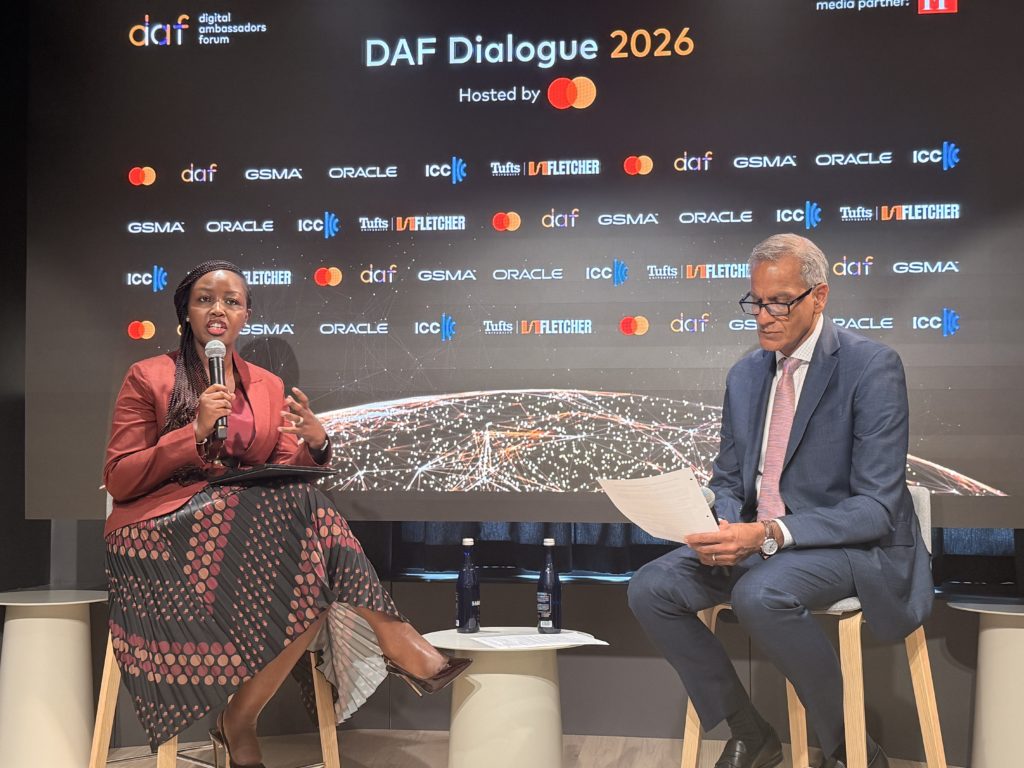
At Mastercard’s Digital Ambassadors Forum, the world’s tech diplomats argued over who gets to govern AI. The bigger story was who’s being left out of the argument.
The day after Donald Trump told the UN General Assembly that “to the victor go the spoils,” digital envoys from more than 30 countries gathered at Mastercard’s Tech Hub in New York to talk about building rules for AI. Nobody missed the irony. Foreign Policy editor Ravi Agrawal called the United States the “wrecker in chief” of the rules-based order, and no one in the room pushed back.
The word of the day was “sovereignty,” and almost nobody meant the same thing by it. Rwanda ICT and Innovation Minister Paula Ingabire gave the sharpest version: no country has achieved AI sovereignty, and sovereignty “does not mean isolation.” Former Colombian president Iván Duque gave the more worrying one. Citizens want control of their digital lives, he said, and right now politicians hear that as a demand for closed systems. Sovereignty is quietly turning into a word for walls.
The most striking finding was about trust. Agrawal noted that middle powers are hedging against the “Western stack” by adopting China’s open-source models. They know the security risks and do it anyway. A country like Nepal, he said, will “absolutely” adopt Chinese technology. When nations knowingly choose Beijing’s code over Washington’s, that tells you how far American credibility has fallen.
When I interviewed US Ambassador to the United Nations Economic and Social Council (ECOSOC) Dan Negrea, he was blunt: the only thing scarier than “I’m from the government and I’m here to help” is “I’m from the UN and I want to govern.” AI regulation, he argued, belongs to sovereign nations. Then he said that Washington and Beijing are treating AI “the way they treat nuclear weapons” and are discussing a red hotline telephone in case an AI system escapes its sandbox. So the two superpowers make the deals, and the other 190 countries keep up an illusion of control.
The gap underneath all of this is the one that matters most. The World Bank’s Sangbu Kim reminded the room that 2.2 billion people still have no internet, and that local languages are barely represented in AI. Ingabire said a Rwandan farmer doesn’t care whether a tool is “AI.” What the farmer wants is predictability. Amandeep Singh Gill, UN Under-Secretary-General and Special Envoy for Digital and Emerging Technologies, called it a governance divide, not a development divide: countries that can’t evaluate these systems can’t trust them.
Backlash is already here. Gill saw anti-AI protests in Montreal for the first time. Former GCHQ chief Sir Jeremy Fleming pointed to protests against data centers, because nobody has made the public case for AI’s “license to operate.”
On a panel I moderated, Mastercard’s Heba Shams said success can be measured in trust, and that right now we’re measuring its absence.
Take away the diplomatic language and three insights stand out. First, the AI race won’t be won by whoever builds the biggest model. It will be won by whoever reaches the next 2.2 billion people, and China’s open-source giveaway suggests Beijing already understands that. Second, sovereignty without the ability to test these systems is just branding: a country that can’t check the code it runs is renting its future. Third, trust has become the scarcest resource in the digital economy, and no superpower can just order it into being.
Finally, The UN’s Gill noted that in parts of Asia, data plans are already turning into token plans. The next digital divide may not be between the connected and the unconnected. It will be between the countries writing the rules for AI and the ones paying for it, one token at a time.
— Steve Clemons

